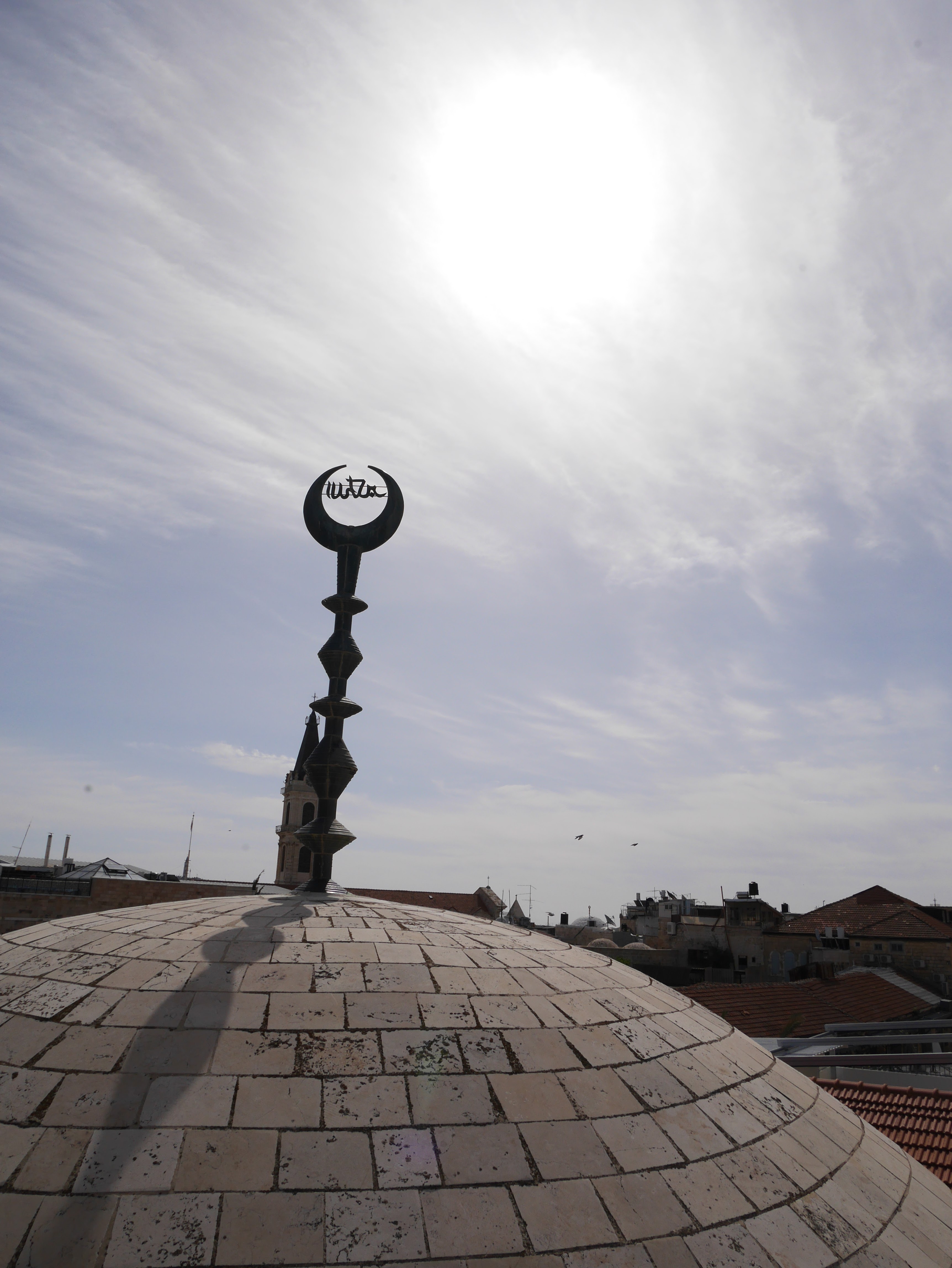
Saturday in Jerusalem - the streets were very quiet, continuing from the start of Shabbat last night. Beth and I walked around early to people watch.

Eric picked us up and drove us to a Yemeni coffee shop that he knew was open. In an amazing Judaism workaround (you can't cook or use electronic things like lights, appliances and a POS machine for taking payments), this enterprising place had food prepared from yesterday and took Alex's number down to send him payment information at the end of shabbat - there is always a way.
Our destination was the Israel Museum, but on the way, we stopped at the Knesset (the national assembly/parliament building). Outside the gate was a huge, bronze menorah that hid all kinds of symbology and historical events carved into the seven pronged candle holder.t
The Knesset Menorah (Hebrew: מנורת הכנסת Menorat HaKnesset) is a bronze Menorah 4.30 meters high, 3.5 meters wide, and weighs 4 tons. It is located at the edge of Wohl Rose Park opposite the Knesset. It was designed by Benno Elkan (1877–1960), a Jewish sculptor who escaped from his native Germany to Britain. It was presented to the Knesset as a gift from the Parliament of the United Kingdom on April 15, 1956 in honour of the eighth anniversary of Israeli independence.

Facing the Knesset, Eric gave us the crib notes of how politics works in Israel - very much of a forced coalition situation right now as the 100 seats are controlled by a large number of parties. It's an interesting take on proportional representation, as the people that go to the Knesset (seats) are sent based on a internal rank of their party and how many seats the party one. You aren't choosing a local representative, you're voting for a party and they are deciding by rank, who gets in the Knesset and who doesn't. There is no geographical representation. I guess that works for a small country, but the way Eric described it, they are as gridlocked as many modern democracies are these days.

This led to a discussion on the Palestinian situation. Israel is a pretty confusing country as you can probably tell from previous day's musings, but in terms of movement and who can go where, see if you can follow this....
In the picture below, the entire area inside the green (Areas A, B and C) is the part of Palestine that Israel took over in the 6-day war in 1967. Called the West Bank (counterintuitive to us, but it refers to the west bank of the Jordan River that separates Jordan and Israel). Same goes for the Gaza strip - a heavily Palestinian area also taken in the same war.

So, everything after this, is still in dispute, but it's also at a "status-quo" for the most part..... So area C (the white area), that is run by Israel, looks and feels like Israel - there's no border or checkpoint and any Israeli can move freely anywhere as if it was part of Israel. All Israeli settlements are in Area C - usually small or medium towns built around a hilltop.
Area B (the yellow area) falls under Palestinian civil control (health, education and the economy) and has joint Israeli-Palestinian security control. It contains 440 Palestinian villages and but no Israeli settlements. Area A are the higher density areas in the Palestinian territories including the cities of (Nablus, Jenin, Tulkarem, Qalqilya, Ramallah, Bethlehem, Jericho and 80 percent of Hebron).
Area A is basically walled off, has security checkpoints going in and out, and is forbidden for Israeli citizens to enter. Of course, Israeli military retains the right to enter any area at any time, typically to raid homes or detain individuals in the name of security.
Now, we were getting everything from Eric, which actually seemed factual from both sides of the situation, but obviously prejudiced from his side in certain matters. But we also looked at facts to validate things he was saying... one today stood out. The Palestinian Authority has an official policy of a martyr fund, essentially rewarding violence against jews... that's a tough one to get behind. On the flip side, area C, which contains 99% of the natural resources of the Palestinian area remains out of reach of development by Palestinians as Israeli's won't let them build anything on that land. I found an essay from 2014 and a identical UN one from 2019 that essentially says, without access to area C, the Palestinian economy will remain stagnant (making martyr payments for poor people pretty attractive I guess).It's pretty confusing, but now that I research it and reflect on what Eric was saying it's much clearer to me. Anywho....
Eric did a great job with the Israel Museum. We were there to cover two things. The first one was the incredible large scale model of Old Jerusalem in the time of the second temple (built by, who else, King Herod). Having toured the city the day before, it was a great way to see how the old city had changed. The model was originally built at a nearby hotel, but when the owner passed away, he gifted it to the museum. Very cool


On the way in to the museum, Eric had pointed us to what looked like a stuppa you'd see in Nepal (this isn't my picture, lol)....
So as we descended underground in the museum, he started telling us the story of the dead sea scrolls... old (2,000 years!) Hebrew texts and snippets from their bible that were found in the early 1950's preserved in clay pots in the mountains overlooking the dead sea. The white structure that we saw, was the top of the clay jar, and we were entering the underside where the scrolls were displayed (also not my picture)...It was mid-morning, and after the museum we hopped in the car and drove out to another one of King Herod's amazing constructions. Herodium national park, just to the South side of Jerusalem, was another epic achievement - this time building on top of (and raising) a small mountain. His designers really knew what they were doing with water management, as the place was covered with cisterns for trapping water. A lot of the original plaster and some of the paint was still visible. There was another short movie there that also helped us envision what is once was.


We wanted a taste of the restricted area of the West Bank, so the one that made the most sense was Bethlehem. Eric brought us to a friend he knows that owns a tourist restaurant in an old orthodox church, so we chowed down while listening to Eric's plan for us. Eric, as an Israeli, is not allowed inside Area A, so a Palestinian contact he knows, George, would take us in. Eric warned us in advance that the first stop would be a wood carving factory as that is how George makes money, and we were fine with that. Actually, put us at a shawarma/meze food buffet and we'd pretty much agree to anything... "yeah, yeah, whatever, can you pass the hummus?"

George was a nice guy, and we chatted as we hopped in his smaller vehicle and drove us through the secrurity checkpoint into Bethlehem without delay. George was well travelled (he liked Greece!) and was not very religious. He relied on tourism, so like so many, had struggle quite a bit over the last 18 months. Usually, Bethlehem was a huge attraction for Christian reli-tourists (like a religious eco-tourist?) - we were sure glad that wasn't the case today, as we probably would have gone to Jericho or another PA city.
The wood factory place was run by a Christian family. I know that because during his droning tour he must have mentioned the word "Christian", I'm not kidding, 75 times! Dude, yes, you're very non-threatening... but we're not really Christians! Anyway, the shop above the "carving area" was chock full of mostly cheesy religious crap... not our cup of chai.

We were led to a mini-van and joined by a young woman that was to give us a tour of the Church of the Nativity, the so caled Birth of Jesus church. The guide was actually the best thing... she was young and super positive and knowledgeable, so we began to pepper her with questions. She was part of the Christian minority in Bethlehem, and she said a cute statement that really told us a lot about where they are in terms of women's rights and how far they have (or haven't) come culturally, in relation to Israel...
"My father did not want me to go in to tourism. 'That's a man's business, and you'll never be successful!', but he went away to Jordan for work for a year an a half, so I enrolled in tourism at University and... LOOK AT ME NOW" she exclaimed. So awesome. I asked how her Dad thinks of her profession now and she said "He tells everyone he can about me and how well I'm doing". So awesome.
The Church where Jesus was "born" was actually a couple of churches melded together, with the same kind of competitive vibe between the various sects of Christianity that we saw in the old city yesterday. When the Greek Orthodox guys had their turn at "making the rounds" with their holy smoke, they practically barreled into tourists scooting out of their way.

I think if this was a normal volume of tourists, we would have no business coming to the church. Apparently you can line up for up to two or three hours before getting into the little grotto under the front section of the church to touch some kind of star in the ground where blah blah blah... I'm chuckling, but I just don't care about that aspect of religion.

The drive out was fascinating. The security lines were long at the entry point we used, so George took us to a different out. Bethlehem, like most settlements in this part of Palestinian territory are built on a hilltop, so the elevation of the city was pretty crazy at points. The graffiti on the security barrier walls was cool, but a little sad. For so many different reasons, the people of Palestine are not doing as well as the people of Israel.


We left Bethlehem and George returned us to Eric. We meandered back into a very quiet city..... the sun was not down yet and shabbat went on.

At the break of shabbat, Jerusalem slowly started to coming alive. We found an outdoor table at a pub-like place on the pedestrian mall streets next to Jaffa, and were entertained by our Harry Potter loving waitress. It was weird suddenly seeing the streets teeming with people and vehicles, and businesses opening up. We reflected on when Sundays were still closed down at home when we were growing up, and how alien that seemed to us. Still, more and more, I'm learning that Judaism (at least the non-super-orthodox type!) is really a playbook for how to live a good life - spend time with family and no technology for a day a week? That sounds pretty good!

.jpg)