Thursday, July 4, 2019

Day 8: Training day

Train transfer... yes!  The Versly and Tyndall’s are huge fans of trains and today’s experience on the Peruvian Rail train from Puno to Cuzco was spectacular.


Jorge met us at 640am and expertly accompanied us from the lobby to a waiting van to the main train station in Puno, where he checked us in and handed us our boarding passes.  From there, a uniformed usher took the eight of us and showed us to our car and our two groups of four seats (of course grouped by adults and kids!).

Our main service guy, a serious middle aged man named Sammy would take care of us on the 10 hour journey up to the top of the climb in the middle of the Andean high plateau, and down into Cuzco.  Throughout the day we had drinks, tea, water and snacks served to us, and a three course gourmet meal for lunch with a full complement of silverware (eat your heart out Air Canada!).


Once in the morning and again in the afternoon, there was a fashion show in the bar car and observation car (that featured fellow viewing windows and an open air rear to take some quality pictures and get your face in the wind!), followed by dancing and a small three piece band. 


There were welcome drinks featuring pisco sours and little dried corn and banana snacks.


Beyond the amazing service and ambiance of the train itself, the terrain was pretty spectacular.   We started off in the same upper plateau terrain, first passing through the contraband town (where we actually passed directly through the market that must have stretched over two kilometres and had pretty much everything you could think of) then into open countryside.


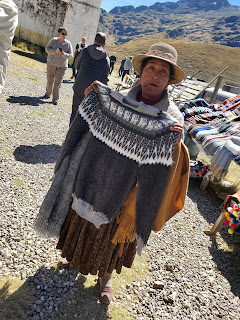
After a few hours we began to climb and we got into snowy mountain territory.... beautiful.   At the high point in the trip, at close to 4,400 meters above sea level, we stopped and got out to stretch our legs and were accosted by a handful of local women selling everything Alpaca.  I say accosted, but really the Peruvians have been very laid back and not in your face all trip.   These ladies just had the pressure of knowing they had less than 10 minutes to peddle their wares.   Some of the stuff was pretty irresistible... I even heard a kiwi couple come by us with the husband muttering “I had no inTEENtion of buying anyTHEENG” as he was draped with a brand new sweater and scarf.... lol.




The kids were great, playing cards and chatting most of the day.   Alex and I managed to dominate Kim and Beth at Euchre 4-1 lifetime to date (up 8-3 in game 6 in case you forgot ladies) in between reading and landscape gazing.


Right on time, we rolled in at 5:50pm just after sunset and as we’ve come to expect, were met and expedited to our hotel in the heart of Cuzco.  More on Cuzco tomorrow, but suffice it to say, it was the heart of the Incan empire, the first main touch point for the Spanish conquistador influence and the gateway to Machu Picchu so we are all pumped to be here.


We had a hankering for Indian and found a legit Indian place steps from our hotel that was fantastic!   The real Indian chai after dinner was.... oh, I’m drooling on my iPad.  


The kids headed back to the hotel while the adults strolled uphill to the Plaza de Armas.... fantastic.   We can’t wait to explore this city!

Day 7: Lake Titikaka

We met Jorge as promised after breakfast at 8am and boarded our private boat right off the grounds of the hotel.   Jorge gave us an excellent run down of the day’s schedule and started briefing us on the Lake.   


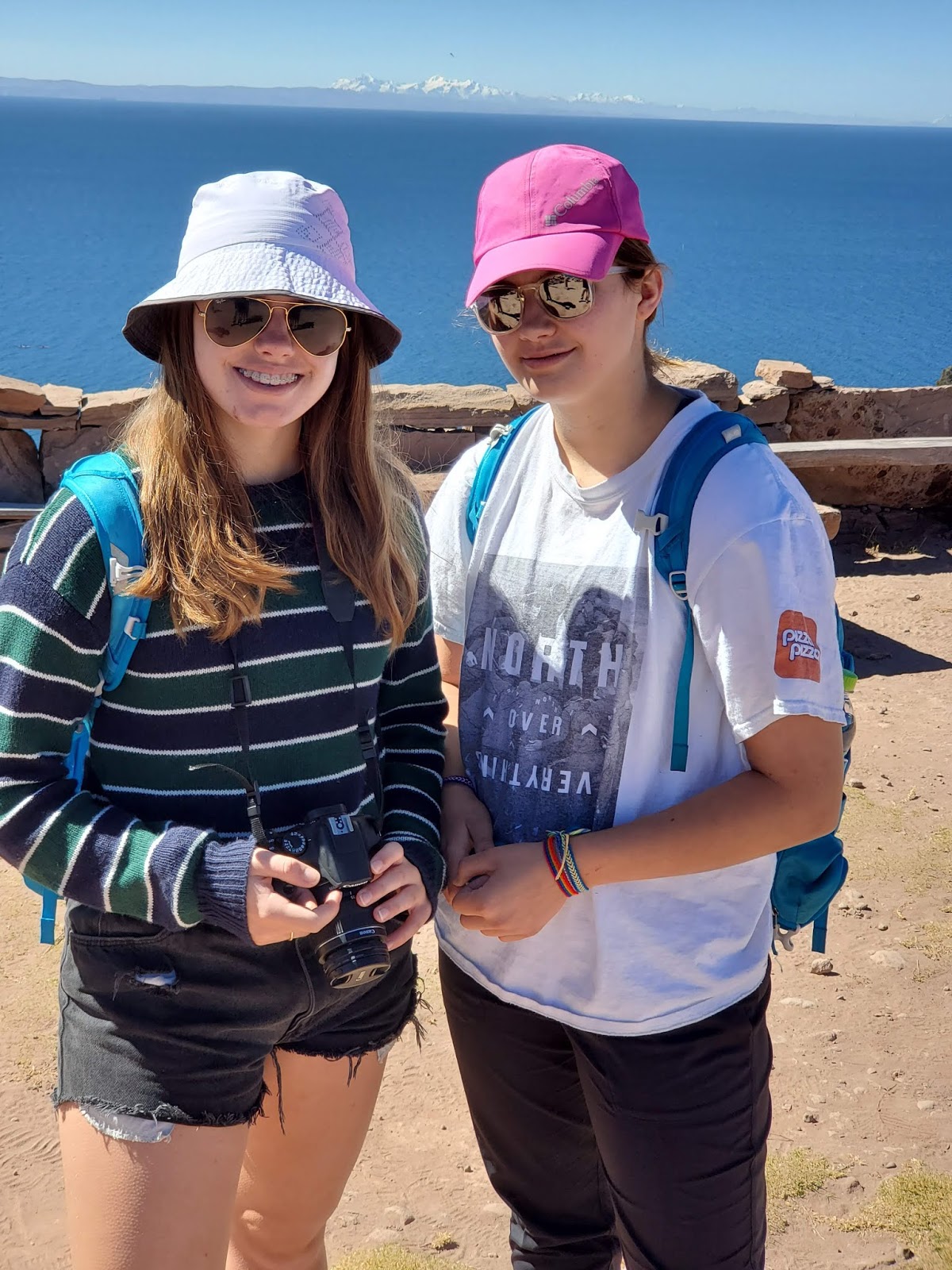
We motored for about an hour before we got out of the “small” bay of Puno, and from there it was another thirty minutes to the island of Taquile.  ().  The island is populated by an indigenous group of close to 3000 people.   We got off the boat on a rock formed dock, and followed Jorge slowly up, up and up along a concrete flagstone walkway that had recently been completed.  The people here were fully autonomous from the Peruvian government, operating on a shared collective basis with local leaders.   The island was about 7 kilometres long and several hundred meters high, as our burning lungs could attest.   We had to take several breaks on the way up where Jorge used the gaps to fill us in on local customs of the Quechua speaking natives (Quechua is one of the 3 official languages of Peru, but I will be damned if I remember one syllable of the words Jorge tried to teach us!).


The views from the top of Isla Taquile were well worth it and we joined Jorge in doing a little three leaf Coca leaf offering for a wish at a small alter of their religion, which was a mix of seventh day Adventist’s and pagan environmental worship.


We hiked over to a little compound where we were given presentations as to how the men in the community were weavers and knitters, plying their craft not only for sale to tourists, but also for tightly woven (drum roll) traditions and celebrations that ran through their lives.  One of the elders, Paulito, also showed us how a young thorn bush, once smashed with a pestle and ,iced with water became an all purpose, effective laundry detergent used by them to wash hair, bodies and clothing. 


Maybe we should bring some on the trek!


This was followed by a little song and dance put on by a small group, after which we were invited/forced to participate in....luckily my hands were full with the hands of a female weaver and could record that awkwardness...


Lunch was great - grilled rainbow trout that had been introduced into the lake by Canadians in the 1940’s.  We walked another half hour, enjoying the views of the lake and the distant Royal Range section of the Andes in nearby Bolivia.  We made our way down to a big sandy beach, where our boat had maneuvered to pick us up.


It wasn’t long before the eight of us were each taking up two seats on each side of the boat and were dozing as we headed back to the bay to check out the famed floating islands (Isla Flotantes or Uros Islands).


Here’s some travelreferatism that came to me as we approached the floating reed islands.... Inle lake in Myanmar... a completely water based culture, that although they didn’t float on water, their community was landlocked and completely unique to Beth and I when we were there in 1997.  These floating communities are often panned as tourist created, hokey facades, but we had a different take.


We got off our boat and sat on reed benches, surrounded by reed houses all on a reed floor that is constantly added to in order to stay above water.   Reed boats were moored nearby.  The elder of this island of 20 people took us through a presentation, translated by Jorge, about life on the islands.   It was fascinating and although we were baking in the sun reflecting off the reed floors, we were kind of captivated by his charisma and his little reed models he kept bringing ups from behind a reed table showing the entire community.

We walked around, checking out their crafts (of course) and some of us got dressed in their local garb for some pictures.  Then, William and another woman had us board a medium sized reed boat where the other members of my party sat on the upper deck and I stood below for some pictures.


They rowed us in to a more developed (ie less reedy area, but still all built on floating reed islands) island they called the “capital” island that had permanent looking buildings featuring a church, general store and even a B&B.   For some reason I still haven’t researched why, but we all got stamps in our passports (?).

The experience was great.  Perhaps they don’t all live as traditionally as we were shown by William in the demonstration, but there was no doubt we’d experienced something very unique and it was just one more life experience we could give to ourselves and our kids to realize the world does not revolve around our customs and ideals.


We got back on our boat and motored through a water way amongst the reeds - we could have been zooming through the Everglades were it not for the occasionally colourfully dressed native fisherman or the clear lack of oxygen.

After another great meal at the hotel, we settled in to watch the semi final of the Cupa America featuring our team (Peru, of course) and the despicable (until we travel there, lol) Chileans.  WE were big time underdogs but thanks to amazing goal tending, WE won 3-0!   The staff went crazy, as far as the fairly reserved Peruvians would let loose.  I know it’s not the World Cup, but damn if great sports results don’t follow this family.... Croat soccer, Peru... RAPTORS!

Wednesday, July 3, 2019

Day 6: High altitude transfer day

Altitude is almost a constant conversations topic on this trip... What’s our current altitude?  Are you out of breath?  Are we going to have altitude sickness?  Don’t over exert yourself!  My head hurts (Beth just said that while I’m writing this).

For sure altitude had been a factor here... when we got to Arequipa at 2,400 meters above sea level, we definitely got out of breath easily (like, after going up one flight of stairs).   We became obsessed with drinking coca tea (a tea derived from the same leaf used to make cocaine).   The effects of “cocaine” alleviate some of the effects of altitude, and as you get higher (in elevation, lol) you see locals chewing on coca leaves quite a bit.  We had read how one serving of coca tea related to a fraction of a line of cocaine (of course, we are ingesting, not mainlining or snorting it!) and now Abby is constantly asking with concern “how many lines of cocaine is this coca candy?”.


We transferred to Puno today, the city that lies nestled in some steep hills next to the guffaw instilling Lake Titikaka (I can hear Alex giggling even as I write that), the highest navigable Lake in the world (how’s that for a travel superlative) at around 3800 meters.

To get there, we’d have to pass over the volcanic mountain range first, then down a bit then over the spine of the Andes, the down to Puno.   This also started our engagement with Explore Andes, the trekking company that we had liked so much we got them to organize the rest of our transport and accommodations from here on in.


So far, so good.  We were met by our guide, Omar (we were intrigued to meet a local Peruvian Muslim, but nope, he was named after a character from Dr Zhivago, lol) and our driver Rui.  The van was super comfortable, a stark contrast from the rafting van.  Omar was great, and gave us a ton of information on Arequipa as we rolled out of town and began to climb into the volcanic range.

Omar had everything planned out, had water for us when we needed it and was very attentive to the tiny bladder gang (Robin, Matt and Beth).  The landscapes were beautiful, rolling desolate hills with the occasional spring fed farming valley.   The two lane highway was cut into the sides of rounded mountains and wound on and on.   Often we would run up against very slow moving trucks, laden with fuel or other goods that were struggling up the perhaps three or four percent grade of the road.   They were pretty easy to pass but you could see why there would be crosses all along the highway eulogizing a victim of a traffic accident.... passing the slow moving trucks at the wrong spot would be hazardous to your health.


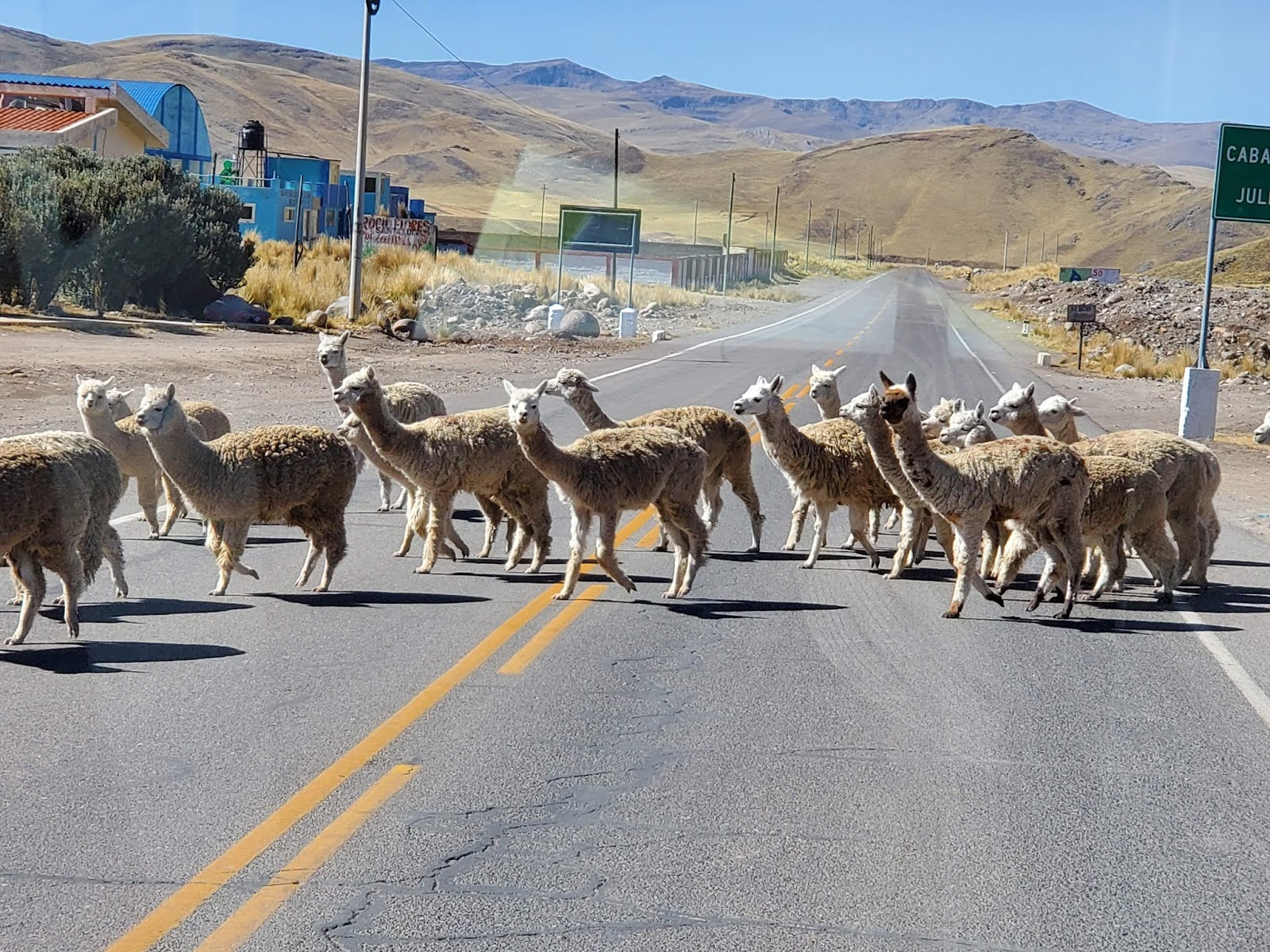
For about an hour, we were in view of the almost fake looking cloud of smoke from an active volcano.   The smoke stood still, hundreds of feet in the air and seemed almost solid to touch.   We passed through a huge protected area, like a national park, where we stopped by the side of the road to snap some pictures of Vicuña and Alpaca.


We had lunch just past the highest point in the drive (4,400 meters), and Omar warned us again about the sun... the sun can burn you very quickly at this altitude, one more thing for the mothers of the group too worry about :-).   The boxed lunch picnic was at a little bend in the road that had some local vendors selling the ubiquitous Alpaca sweaters and other crafts.  It overlooked a beautiful lake (I guess it was non navigable!) and we sat there munching on lunch while watching the cutest little Peruvian boy dressed with a little cowboy hat playing.


The last turn towards Puno was in the large town of Juliaco, a dense, thriving place that reminded me of an Indian city.  The roads were packed and we came to a standstill in traffic, surrounded my tuk tuks, buses and pedestrians weaving in and out.  I couldn’t stop staring at the action.  Omar told me that this city thrived on contraband - buying and smuggling comparatively cheaper goods from La Paz in Bolivia and selling them here.  Prices in Bolivia are half of what they are in Peru, as their economy as not as advanced as the Peruvians.  


Throughout the ride, Omar talked quite a bit about the corruption of local, state and national politicians and government run organizations.  It’s like that throughout South and Central America, he said.  It’s always been like that and they don’t really see how it could ever end.  It sounds very frustrating.   Omar also told us how Chile is essentially universally despised by the rest of South America.   He described them as the “Germany of South America”, and not coincidentally Chile has a large German population and historical connections to that Country.

We arrived at our hotel, nestled beside the lake and perhaps 20 minutes from the town centre of Puno (not much to see there that we’ve heard about).  We were handed off to our local Explore Andes rep named Jorge.  He walked us trough he itinerary for the next day or so, and handed us our room cards (very smooth check in experience!) and soon we were having our welcome drink while watching the kids chase down wild guinea pigs that were literally everywhere.


I forgot to mention... the solar eclipse happened around 4pm, so naturally, Alex pulled 8 pairs of eclipse glasses out of his magical daypack and we all, safely, enjoyed the eclipse.


Dinner saw 8 people with drooping eyes and heavy heads.   We were yawning while downing our tasty food and were soon back at our rooms and tucking into bed.   You would think we’d all been working out or running laps around the town, but no, it was just the altitude I guess.


Day 5: Long day on the water, and in the van

Up at 4:30 and piled in a van for a three and a half hour ride.... that’s how we started a very long day.


Two of the main activities to do in and around Arequipa are white water rafting and trekking/touring in the Colca Canyon (the deepest gorge/canyon in the world by far).   When I was going over the itinerary, it felt like a bit much to do Colca because unless you stayed there, it was basically a leave at “4am return at 11pm deal”... that’s a long day and a long time in a van for the kids.

Rafting was a better option, but it needed up being longer than we’d expected.  

The road out of town was winding out of the Arequipa valley where we hit sunrise on a moonscape, flat plateau with almost no vegetation.  Before we got over to the valley our river was in, we wound down then up out of another beautiful valley that opened up as an oasis in the middle of two moons capes.  This valley area was where the towns were, surrounded by hectares of tiered farms.  All over the road, you could see the election sign equivalents in Peru... painted on stones and houses, and just about anything permanent.


Eventually, we began the descent into the Majes valley - a massive canyon that is essentially the end of Colca canyon regions, but much closer to the sea, and thus shallower than Colca.  Our destination was near a town called Andamayo where the Majes Valley meets another smaller river.


We were served a very basic breakfast while our guides and our very young, coowner of the rafting company set up the rafts.


Claire, originally from Alaska but transplanted in Arequipa after meeting a local guy, was too young, inexperienced and out of her league to run the operation.   Overall, we had a great time on the river, the guides were great and nice, but the whole organization of the event.... lacked.

The rapids were advertised as 3+ to 4 (https://en.m.wikipedia.org/wiki/Whitewater), and Beth and I both had bad thoughts from a pretty hairy incident we’d had in Nepal in 1997, but when I saw the river while driving in, I was right in my assumption that they’d probably oversold the severity of the rapids (or understandably referred to the highest the rapids could get in the rainy season).   They looked more like 1s and 2s, which set Beth at ease.  It’s one thing to take risks with your health when you don’t have kids in tow.


There was no water at “breakfast”, no water in the vehicles and no water (or food) provided at the halfway “snack” stop.   Claire seems like she was just a passenger, more deferring or chatting with the guides than anything.   The guides from both of our boats, one Chilean, one Venezuelan were great, as was the little 19 year old expert kayaker who sped up down the river essentially giving the guides the correct line down the fairly narrow, rocky river.

The landscapes were breathtaking and being in the deep canyon which gradually widened was great to take in during calmer moments on the water.   

At the “snack” break I told Claire that Alex wasn’t looking to good - he was chilly and looked a little white, and I’ve never seen Alex drop even 1% lower than his usually high energy.  I recommend to Claire we get Alex some water and keep him in the middle of the boat to minimize water splashes (we’d gotten through most of the heavier rapids by then) and eliminate him from paddling.  She just looked at me with wide eyes and said “really? Ok... we don’t really have any water but....ok”.   Jesus Christ....

When finished and pulled up to the edge of the river, we had to scramble up through some brush and up to the main, 2 lane road where we proceeded to change into our dry clothes basically in the middle of the road.

Lunch was tasty, but we weren’t really done lunch until around 3:30 (promised return of 5pm, 3.5 hours to driver, get it together Claire!).   The kids were great, chatting amongst themselves and playing cards - in general just having fun.  I think if it was just the 4 adults Claire would have received “words”.  


As we began our climb out of the high valley, the sun started setting.  By the time we got up to the moonscape, the sky was dark and most of us were asleep.  We ended up getting back to the hotel at 8:30.   Pour Alex - today was a long day in the best of times, but that dude is a super trooper for coping pretty well through it all.


We tipped the guides as we appreciated their service.  Claire barely got out of the van and waved goodbye.   Good luck in this business adventure Alaska - hopefully you’ll get better before word gets out that the customer is number 2....

The seven of us ended up having fantastic homemade hamburgers at a little local sandwich shop that we’d walked by a dozen times but never stopped at.  Within 10 minutes of taking our last bite, we were tucked into our rooms and getting some well earned sleep in our comfy beds.   Last night in Arequipa - our adventure moves to a new location tomorrow.